
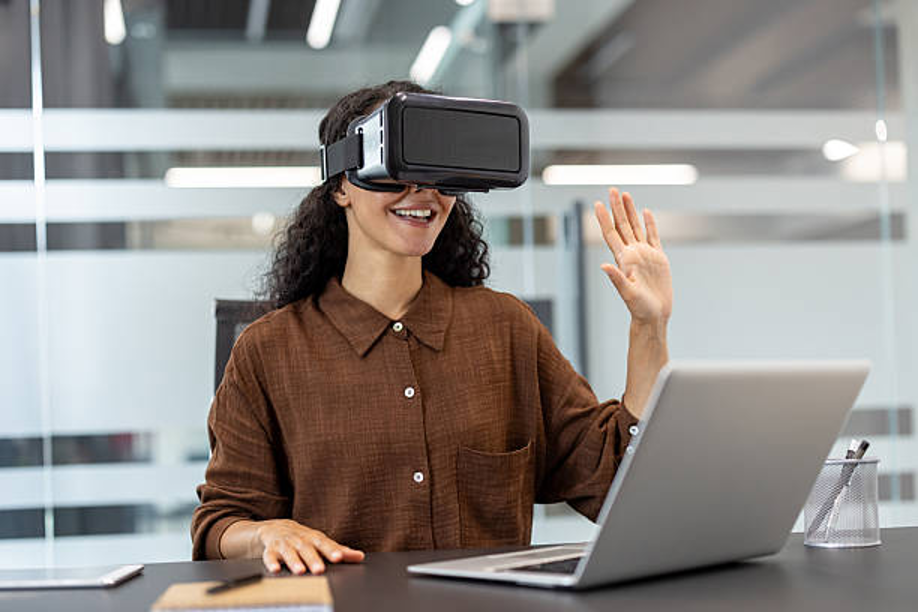
AR has also transcended filters and game capabilities. It has become a formidable technology that integrates digital information into reality. The AR tools are evolving in a very fast way as they become more sophisticated and more affordable and thus are transforming the way communication, learning, work, and entertainment are conducted. AR is not only going to dominate a single industry, but also it is bound to affect all aspects of contemporary life. AR is transforming the way individuals perceive the world, whether working remotely or attending an immersive concert.
The way AR Is Revolutionizing the working environment in the modern world
AR is taking its place in most workplaces. It assists the employees to visualize data, work with 3D objects and get real-time instructions. AR overlays allow remote teams to work more intuitively since virtual meetings become more similar to face-to-face communication with virtual meetings. Employees have access to digital notes that are aligned to actual equipment, and so, they are able to solve issues with blistering speed. Engineering, retail, medicine, architecture, and manufacturing companies have already started to use AR to improve efficiency. With the AR equipment becoming less weighty and more cost-effective, additional organizations will consider it as part of their routine.
Learning and skill building were brought closer to reality
One of the most solid applications of AR is the training. Employees can now learn practicable tasks on a controlled and safe environment rather than using manuals or videotapes. AR provides training in a form of step-by-step instructions and interactive simulations, which enable users to learn more quickly and retain information more efficiently. Medical students will be able to study 3D models of human organs, and technicians could train working with equipment without the threat of its destruction. Such amount of immersion enhances the confidence and lowers the cost of training to companies.

The Growing Entertainment role of AR
Entertainment is quickly evolving with AR experiences that integrate the digital into physical places. The games are increasingly becoming interactive where individuals can move around and engage virtual characters either at their homes or in the fields. AR is also redefining music and performance events. There is the ability to combine holograms, digital effects and interactive visuals, which will bring the audiences closer than ever before. Sports broadcasting is also getting enhanced through AR overlaying which points out the statistics and movements on-the-fly. Such experiences are more intimate, interactive, and effective.
The way AR Is Improving the Everyday Consumer Experiences
AR is slowly entering the daily life. The shopping process is made easier by virtual try-on features that enable customers to preview how garments, eyewear or interior decorations will appear. Movement applications have an option of adding directions on the streets and buildings to navigate easily.
The main enhancements that AR will introduce to everyday life are:
- Real-time visualization and ease in decision making.
- Beyond mass customization of products.
- Improved learning using interactive images.
These applications provide evidence of AR not being an imaginative notion in the future but a logical extension of the physical world.
AR Collaboration Tools Making the World a more connected place
The cooperation is growing to be more vibrant with AR meeting platforms. The user is able to see the shared documents, 3D models, and visual notes in the surrounding. This contributes to the sense of natural teamwork at a distance. The advantages of the system to businesses include expedited approvals, enhanced communication, and reduced misinterpretations. AR minimizes the distance constraint since it allows teams to collaborate without distance being a factor. This change is particularly helpful to international organizations that use hybrid or remote work groups.
Implementation of AR Hardware and Innovations
The second generation of AR devices will be less heavy, faster, and comfortable. AR is becoming more convenient to use in its everyday form as smart glasses gradually replace the large headsets. Sensors will be more accurate, AI will be more advanced and the connectivity will be better. These enhancements will ensure a smoother and more engaging AR experience. With the development of the devices, the industries will additionally find solutions in using AR to resolve issues and to enhance the working processes.
Future Problems and opportunities of AR Adoption
With the development of AR, there are issues that require consideration. Adoption is still slowed down by the cost, privacy issues, and technical constraints. Other users might be overwhelmed with excess digital information in the environment. Nevertheless, these obstacles also give innovation opportunities. Enhanced privacy settings, more user-friendly interfaces, and more user-friendly designs will contribute to the potential of AR. As the research and development is being done continuously, AR will keep gaining new markets and becoming a regular element of contemporary life.

Conclusion
AR is shaping up to be one of the most powerful technology in the future. It is redefining the workplace, changing entertainment, and making the everyday life more interactive and meaningful. With the constant enhancement of AR tools, more industries will use them to enhance productivity and develop more interactive digital experiences. The future of AR is one in which digital and real worlds merge with each other without any difficulties, creating opportunities to be creative, collaborate, and innovate.









Leave a Reply