
March 11, 2026 – Chiang Mai, Thailand | Nvidia is no longer just a company selling a chip; they are now all-in on who will create the next intelligent systems. In a move that shows just how much Nvidia has become a part of the future of AI, the company has recently announced a “significant investment” into the ambitious startup Thinking Machines Lab, founded by former OpenAI chief technology officer Mira Murati. This move, coupled with a promise from Murati’s startup to put at least one gigawatt of Nvidia’s technology into the world starting early next year, shows just how much the race to create the next intelligent agent has become a battle of sheer computational power.
It’s not a trivial wager. It’s Nvidia putting itself at the heart of the agentic AI revolution—the next generation of AI, from chatbots to autonomous systems that think, reason, and act over vast periods of time. But with the churn at Thinking Machines and the sky-high valuations already under the microscope, is this alliance the masterstroke it seems, or is it a risk worth taking?
Why This Partnership Matters Right Now
Agents will be the next frontier after the current generation of foundation models. Unlike the current generation of agents like ChatGPT, these will be able to break down complex goals into smaller tasks, utilize tools, have the ability to remember past conversations, and interact with the real world. This means agents will be able to schedule trips while checking the budget or negotiating a deal. Nvidia currently has the de facto hardware for the current generation of massive models. Now they want to secure their position as the leader in the inference-heavy and real-time world that agents will require. By investing in Thinking Machines and securing a commitment for a gigawatt-scale deployment of the company’s agents using the Vera Rubin systems Nvidia is currently building, they will have access to the very best agent architectures that will be required for the massive GPU sales of the future. For the Murati lab, still relatively young and without a blockbuster product to its name, the deal will give it credibility and a powerful ally in the fight against the likes of OpenAI and Anthropic.
Deep Dive: What We Know About the Deal & Thinking Machines Lab
Thinking Machines Lab began in early 2025, staffed by a dream team of ex-OpenAI personnel, such as co-founders John Schulman and, for a brief period, Barret Zoph. In July 2025, Thinking Machines Lab raised what many termed the largest seed round ever, amounting to approximately $2 billion in funding at a post-money valuation of $12 billion. Its investors include Andreessen Horowitz, which led the round, Nvidia, AMD, Cisco, ServiceNow, Accel, and Jane Street. (Reuters, TechCrunch, Wired – July 2025) In late 2025, rumors began to circulate regarding negotiations for a follow-on round, valuing the firm at $50–60 billion before any product releases. Issues also began to arise, with multiple co-founders and researchers leaving the organization, some returning to OpenAI or Meta, sparking concern regarding the organization’s stability and ability to execute on their vision. Nevertheless, the March 2026 announcement regarding their partnership with Nvidia, utilizing a gigawatt of compute from Vera Rubin Observatory, beginning in 2027, demonstrates the continued faith in Thinking Machines Lab from their investors.
Disclaimer: Exact investment size remains undisclosed by both parties. All figures and timelines are based on public reporting and should be treated as approximate until official confirmation.
Historical Context: Echoes of Past AI Investment Cycles
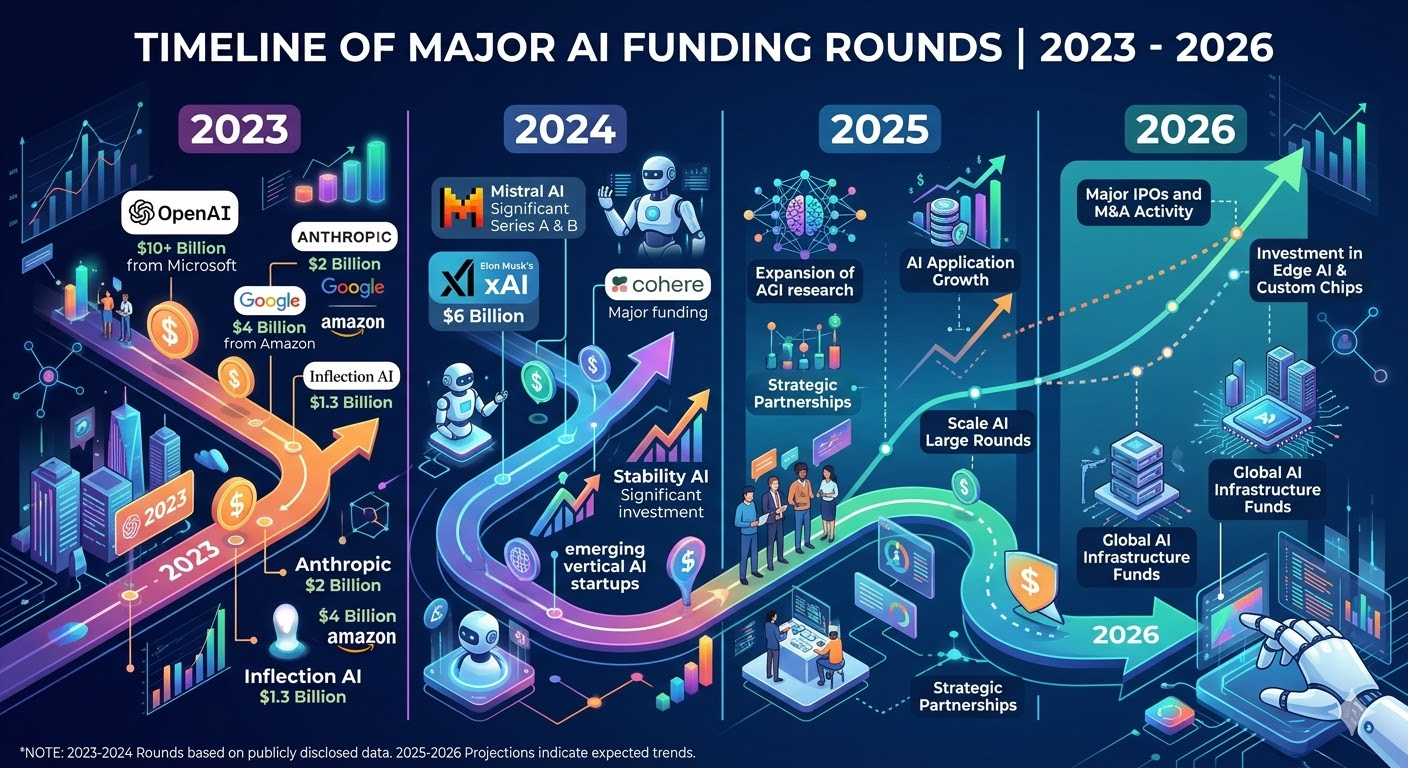
Flash back to 2023-2024: OpenAI’s valuation rose from ~$29B to over $150B due to hype, talent wars, and compute constraints. Anthropic’s growth followed a similar arc. $12B seed for Thinking Machines in mid-2025 was seen as crazy at the time, but $50B+ rumors in late 2025 weren’t unreasonable in that market environment. Nvidia’s involvement is similar to past investments: backing xAI, indirectly supporting Anthropic with compute deals, and now solidifying ties here. What’s common in these stories so far? Pedigreed teams and exclusive hardware access create barriers to entry. However, past performance also teaches us that overhyped rounds lead to down rounds or fire sales when companies fail to deliver. Talent drain at Thinking Machines reminds me of Inflection AI’s 2024-2025 woes before Microsoft’s partial acquisition.
Key Risks Facing Thinking Machines & Nvidia’s Bet
-
- Talent retention: Multiple high-profile departures in late 2025/early 2026 hurt momentum and IP continuity. Losing co-founders so quickly is a red flag in a field where people are the product.
-
- Execution risk: No flagship product has yet captured mainstream attention. A gigawatt of compute is meaningless without breakthroughs in agent reliability, safety, and usefulness.
-
- Valuation gravity: Jumping from $12B (seed) to rumored $50B+ without proportional revenue or user traction invites skepticism—especially if broader AI hype cools.
-
- Competition: OpenAI, Anthropic, Google DeepMind, and new agent-focused labs (e.g., World Labs by Fei-Fei Li) are all racing in the same lane, many with deeper pockets or more mature ecosystems.
Outlook: Bullish Signals Amid Caution
On the plus side, Nvidia’s dual position of investor and primary compute supplier creates tremendous alignment. The Vera Rubin architecture, which promises to drastically reduce inference costs, may also provide Thinking Machines with a competitive advantage in deploying cost-effective agents. If Murati and his team are successful in their goal of “collaborative general intelligence,” then this partnership may be seen as a poster child for symbiotic success. Trends in 2026 may also bode well for agents in general, such as Nvidia’s rumored open-source agent platform, NemoClaw, which was reported in Wired magazine in March 2026. Additionally, increased interest in physical AI/robotics and enterprise pilots may also indicate that agents are ready to move from concept to production. Nvidia’s stock price remains high despite macroeconomic headwinds, partly due to investors realizing that Nvidia is the pick and shovel play of choice regardless of which agent vendor comes out on top. However, it’s also important to keep in mind that AI labs come and go, and there are many examples of overhyped labs that rose to fame only to fade from relevance.
“The real race isn’t just who builds the smartest model—it’s who builds agents people actually trust and pay for at scale.” — Anonymous AI investor, early 2026

